💘 Want the Dating Tips That Actually Work?

Choose your path and get powerful attraction secrets tailored for men or women:

Friday, June 26, 2026

What Would You Do If You Weren’t Afraid to Fail?

What Would You Do If You Weren’t Afraid to Fail?

I’m very emotional today. And when I’m emotional, I have to write about it. And somehow tie it back to dating and relationship advice. So here goes:

The New York Knicks won the NBA Title for the first time in 53 years. I’m 53 years old. I’m from New York. Their journey is my journey. As you’ll see, their journey is also your journey. 

This is a team that has failed in ways, big and small, for decades. Sometimes, they lost due to bad luck (going against Michael Jordan at his peak). Sometimes, they were outplayed (losing in the Finals in 1999 against a better team). And, for decades, they made a lot of questionable decisions – bringing in high-priced coaches and players who lacked character and didn’t perform up to their potential. 

As a Knicks fan, I suffered silently, making the best of a bad situation, knowing full-well that the results were beyond my control. But in the past few years, everything changed.

The owner brought in a general manager who had a vision. The team would be filled with high-effort, high-character players who may not have the biggest names but also wouldn’t have the biggest egos. Guys who knew the meaning of teamwork and sacrifice. 

Their leader was a point guard named Jalen Brunson. Even though he won high school and college championships, no one thought he was good enough to lead a pro team. Too short. Not athletic enough. Jalen Brunson just scored 45 points in the final game of the series. Same as Michael Jordan in 1998. 

He’s now a legend in New York. Here’s what he had to say after the game.

“I’ve always told myself, and I’ve always been taught by my parents: Never be afraid to fail. You put the confidence you have in everything you do when the lights are on because of everything you’ve done when no one is watching.”

This quote is the reason I’m writing to you today. Because it echoes MY favorite quote – which I have on a painting in my home – “What would you do if you could not fail?”

So,  what would you do if you weren’t afraid to fail?

What would you do if you weren’t afraid of going back online?

What would you do if you weren’t afraid of going on one date a week?

What would you do if you weren’t afraid of getting rejected by a man you really liked?

What would you do if you weren’t afraid of being vulnerable?

What would you do if you weren’t afraid of getting hurt?

The truth is, you don’t lack romantic love because you’re unworthy. If anything, you have underestimated what you’re worth in love, and after years of disappointing relationships, you’re afraid to take the risks required to get what you want.

If fear has been making your decisions – quitting online dating, giving up on men, convincing yourself life is better alone –  you’re not playing to win. You’re playing not to lose. 

The question isn’t whether you’ll ever get rejected or disappointed again, any more than Jalen Brunson could guarantee the Knicks would win.  

The question is whether you’re willing to let your past keep you from creating the future you’ve always wanted.

Love,

Evan

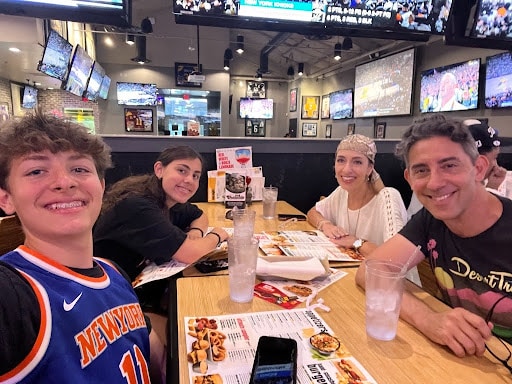
My family, watching the final game, together. 


* This article was originally published here

Friday, June 19, 2026

How to Spot a Secure Man in 5 Minutes

I’ve been a dating coach since 2003.

During that time, I’ve read dozens of books on psychology, relationships, communication, and attachment. Some have taught me something new. Some have challenged my assumptions. Most have reinforced ideas I was already seeing play out in my coaching.

But every once in a while, I come across a book that makes me stop and think, “Finally. Someone put the science behind what I’ve been observing all along.”

That’s exactly how I felt reading Amir Levine’s new book Secure.

You know Levine from his blockbuster bestseller Attached, in which he popularized the idea of anxious and avoidant attachment styles. In Secure, he offers the solution on how to act secure and choose a secure partner. 

I read the entire book in a week and finished feeling validated. In fact, there were multiple moments where I found myself highlighting passages and thinking, “I’ve been saying this for years.”

Here are five places where Secure and my work converge in ways that made me smile.

1. We both believe security is defined by consistency.

One of Levine’s definitions of a secure partner is someone who is CARRP: consistent, available, responsive, reliable, and predictable. 

My terminology for the traits that a good partner must have are: character, kindness, consistency, communication, and commitment. 

Pretty similar, huh?

It shouldn’t be surprising. If a man consistently shows up, follows through, communicates clearly, and treats you with respect, your nervous system relaxes. 

That’s what secure attachment looks like.

2. We both encourage you to lean on secure people.

One of the most interesting ideas in Secure is that when your attachment system is activated, you shouldn’t isolate. You should turn to secure people who help regulate your emotions instead of amplifying them.

My clients don’t hire me because I can magically hand them a husband. They hire me because when they’re spiraling, catastrophizing, or making excuses for emotionally unavailable men, I offer a grounded perspective that brings them back to reality. 

This is often a healthier approach than asking your friends – many of whom are in bad relationships or struggling with the same issues as you. 

3. We both emphasize real-time intervention. 

One passage that particularly struck me was Levine’s observation that the most effective interventions often happen in the moment, before old attachment patterns have a chance to take over. 

This is why coaching works better than consuming content or therapy. Reading a book is valuable. Venting to a trained professional for 50 minutes is valuable. But when you’re three dates into a confusing situation and your anxious brain is spinning out, you need someone who can interrupt the cycle before you repeat another mistake.

My clients know they can call or email any time and I will get back to them ASAP.

4. We both describe secure relationships as collaborative. 

Most online advice focuses on the problems with “people pleasing” and “codependence.” that treats men as your combatants instead of your collaborators. 

One of my favorite concepts in Secure is the idea that securely attached people don’t spend their relationships negotiating power. They naturally collaborate.

You’ve heard me describe the best relationships as “easy”? That’s what Levine is talking about and that’s a very different model than constantly setting boundaries with someone who resists your needs. 

In truly healthy relationships, both people are equally invested in each other’s happiness.

5. We both focus on the effectiveness of treatment above all.

Levine isn’t interested in labeling people as broken. He’s interested in asking whether a strategy is working. That’s been my coaching philosophy from the beginning. It’s never “right vs. wrong.” It’s “effective vs. ineffective.”

I don’t spend much time debating whether your behavior stems from childhood wounds, attachment injuries, or personality traits. The more useful question is simple: Is what you’re doing getting you the relationship you want?

If the answer is no, we change the behavior.

At the end of the day, both Secure and I are trying to accomplish the same thing: to stop repeating old relationship patterns, and to start building relationships that feel good.

His contribution is explaining the science of secure attachment. Mine is translating those principles into practical decisions that smart, successful women can apply while dating.

Love,

Evan


* This article was originally published here

Saturday, June 13, 2026

Why Dating Feels So Much Harder Today

A year ago, I submitted a piece to the New York Times called “In Defense of Love,in which I pushed back against the idea that men are bad and marriage is dead. I argued for hetero-optimism: the belief that a happy marriage can still be yours.

Last week, the New York Times published an article called “There’s Nothing Wrong With Wanting Men.”  It cited many of the same studies, referenced many of the same cultural trends, and used the same phrase: hetero-optimism.

Whether the author ever saw my article is beside the point. The bigger question is why so many people have lost faith in love in the first place.

I think I know the answer.

The Rise of Texting (2010)

Texting is the most ubiquitous—and worst—form of communication.

It’s great for sending memes, sharing articles, flirting during the day, or letting someone know you’re running late. Yet people now use texting to get to know dating prospects and conduct important relationship conversations, and it’s woefully inadequate for both.

Five minutes on FaceTime creates more connection than fifty text messages. Yet because texting is easy, we’ve turned it into the primary language of modern dating, even when it works against us.

The Rise of Social Media (2012)

Facebook, YouTube, and Instagram already existed. Then they moved onto our phones.

As algorithms became more sophisticated, they discovered that outrage keeps people engaged. The same polarization that infected politics eventually infected dating.

If you’re a left-leaning woman online, you’re likely to be fed content highlighting the worst men. On the other side, the manosphere gets rewarded for broadcasting misogyny. The extremes get amplified because the extremes generate clicks.

Meanwhile, most men and women sit in the middle wondering how the conversation became so hostile.

The Rise of Dating Apps (2014)

Dating sites like Match encouraged people to tell stories about themselves. Profiles were long. Conversations happened by email. Emails led to phone calls. Phone calls led to dates.

This was the 1995-2010 version of courtship, and it worked pretty well.

Dating apps replaced that process with a handful of photos and a few one-line prompts. The result is a system that rewards looks and leaves almost everyone feeling disposable.

People then conclude love is broken when the real problem is the way they’re looking for it.

Humans Are Tribal

Imagine that the media published articles with titles like “The Trouble With Wanting Women,” “Women, Where Have You Gone?” or “Why Men Are Tired of Womankeeping.”

It would be credibly accused of misogyny. Yet these are the kinds of headlines being written about men in major publications on a regular basis.

If normal men repeatedly hear that men are the problem, some will become defensive, some will become angry, and some will simply withdraw.

As a single woman seeking relationship advice, you’re likely to see the worst behavior of men in your feed. But the worst is often a function of the systems that have set us up for failure. If an above-average man has to hypothetically swipe on 1000 women to get one date, it’s easy to understand why he’s frustrated and doesn’t want to be told he’s the problem. 

This doesn’t excuse bad behavior from men but it does explain why both women and men are retreating to their tribes.

Learned Helplessness Is Real

We’ve removed depth from dating profiles, turning them into mostly photo-based apps.

We’ve removed email from the dating process, replacing longer conversations with one-line texts.

We’ve removed the search functions from dating sites, replacing them with algorithms that decide who gets seen and who doesn’t.

With so many options and so much competition, it becomes harder to focus on one person. People keep looking over their shoulder, wondering if someone better is one swipe away.

At the same time, most early communication now takes place over text. The limitations of dating apps and texting leave people less trusting and more anxious than ever before.

That anxiety shapes people’s dating behavior, which makes the experience worse for everyone. Case in point:

I was at a dinner party with a woman in her 50s who said she only goes on 25-minute coffee dates. She’s busy, after all, and she doesn’t want to waste time.

But what happens when you put a 25-minute ticking clock on a first date? I’ll tell you: it feels shitty. It makes you feel disposable. It creates anxiety about making a great first impression. If most men left you after 25 minutes, you’d want to quit dating too. 

Sure enough, that’s what people are doing. 

It’s called learned helplessness. If everything you’ve tried isn’t working, the logical conclusion is to give up. But giving up doesn’t solve the problem.

You cannot meet enough people IRL to go out on a date per week. 

You can only use the available tools better.

How To Use Online Dating Better

If dating apps, texting, and social media are creating many of these problems, the obvious solution is to MINIMIZE their role in the dating process.

Guess what? It’s not that hard.

Instead of using dating apps with short prompts and endless texting, I encourage clients to use Match. Write a long profile. Log into the desktop version. Communicate for a few days by email. Move to a FaceTime call. If the FaceTime goes well, have a Saturday night date without a time limit.

Suddenly, dating starts to feel a lot better because you’re only meeting men who EARNED a first date with you.

So why isn’t everybody doing this? Because humans are wired to do what’s easiest, not what’s most effective.

Long profiles take more effort than short prompts. Emails take more effort than texts. FaceTime takes more effort than messaging. Dinner dates take more effort than coffee dates. Yet every one of those things creates more connection and gives you more information about a potential partner.

We keep trying to evaluate compatibility through three prompts, four texts, and a rushed first meeting. It doesn’t work. We all know it. Yet somehow everyone has concluded that the problem isn’t the system but the people. They’re wrong.  


Men and Women Are the Same as Twenty Years Ago

Social media has changed. Dating apps have changed. Texting has changed. Human nature has not. The evolution of a species takes place over thousands of years, not a few decades.

While it would be easy to talk about how bad men are – and there are no shortage of examples – this observation misses the larger point.

Men today are more evolved than at any point in human history. Despite the very real threats to abortion rights and negativity from the dark corners of the incel community, women and men have never been more equal. There’s a lower tolerance for sexual assault and domestic violence. Women have more college degrees, law degrees and medical degrees. Men are doing more housework and childrearing than ever. If you want an egalitarian relationship, the climate has never been better.

You Can’t Solve Society’s Problems But You Can Find a Good Man. 

For women dealing with men who are struggling financially or addicted to porn, gambling, or video games the situation can be difficult. However, if you’re a woman in the top 10% of education and income, the news is much rosier.

There are plenty of quality, commitment-oriented men looking for partnership. In the past two months alone, five clients over 50 have found boyfriends on Match. 

That’s why I remain optimistic. Every day, people fall in love and build happy relationships.

Don’t let a broken dating culture convince you otherwise.

Love,

Evan


* This article was originally published here

Sibling Therapy Is on the Rise. Could It Help My Relationship With My Brother? - The New York Times

Sibling Therapy Is on the Rise. Could It Help My Relationship With My Brother?    The New York Times * This article was originally publishe...